
Internal knowledge assistants · UAE
An internal assistant that cites its sources and says when it doesn’t know
For operations and IT managers whose staff search policies, procedures and contracts to answer the same questions. We build an assistant for one approved source library, with citations, access rights and a clear answer when the documents don’t cover the question.
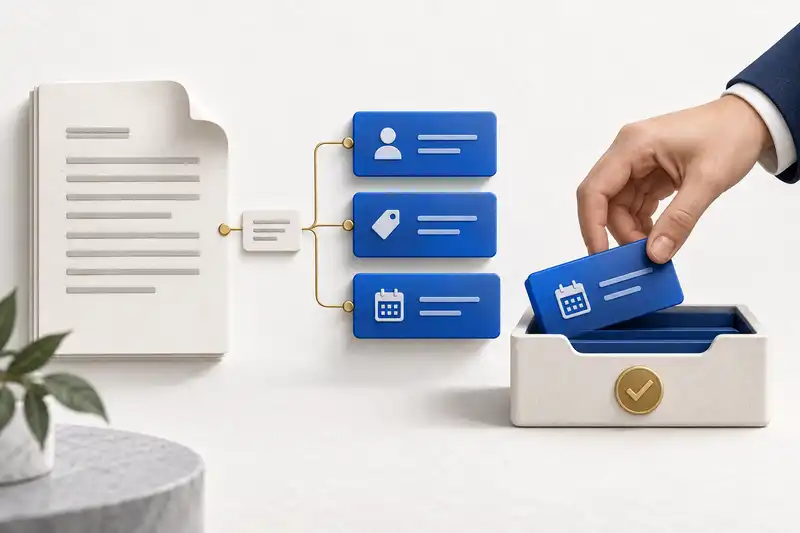
- Answers cite the source
- Access rights respected
- Declines unsupported questions
- Free 30-minute discovery call
The problem
Who this is for.
One department with one library of approved documents and a steady stream of the same questions.
HR and admin policies
Leave, travel and expense questions that go to the same two people.
Operating procedures
Site, workshop or service procedures staff need in the moment, in Arabic or English.
Contracts and specifications
Finding the clause or requirement that applies, with the page it came from.
What changes. Staff get an answer with the passage it came from, or a clear “the approved documents don’t cover this” and who to ask. Nobody sees content they are not allowed to read, and outdated documents are not used as if they were current.
Illustrative question flow
One question, from asking to a cited answer.
A generic example with synthetic documents, not a client deployment. It shows the controls, not measured performance.
Ask
A staff member asks a question in Arabic or English.
Check access
Before searching, the assistant checks which documents this person may read.
Retrieve
It finds the relevant passages in the current, approved versions only.
Answer or decline
It answers with citations, or says the documents don’t cover the question and names the owner to ask.
Learn
Unanswered questions are logged so the document owner can fill the gap.
Suitability
Where it fits, and where it doesn’t.
A good fit
One approved library
A defined set of documents with an owner who keeps them current.
Repeated questions
The same questions come up often enough to matter.
Known access rules
It is clear who may read which documents.
A place to use it
Staff already work in a portal, Teams or an internal system it can sit in.
Probably not a fit yet
“All our files”
Every shared drive at once, with no owner or version control, produces unreliable answers.
Answers that must never be wrong
Legal or safety decisions need a person; the assistant can point to the source, not decide.
No document owner
Without someone to keep sources current, answers drift out of date.
Your office suite already does it
If an existing assistant covers your library and permissions, use it.
Integration
Integration boundaries.
Sources
The agreed library only, through its document store or an agreed export.
Identity
Your existing sign-in and groups decide who sees what.
Freshness
Superseded versions are excluded or clearly marked; the source owner controls updates.
Processing
Where it runs and which model provider processes text are agreed per project.
Control
Acceptance tests we propose.
Citation check
Does each answer cite the passage that actually supports it?
Abstention
Are questions the documents don’t cover declined rather than guessed?
Two-role access
Do two users with different rights see only what each is allowed to?
Outdated sources
Is a superseded document ignored or flagged?
Pilot
What a pilot delivers.
One department, one source library, one sign-in model and an agreed question set. Scope and price are confirmed in a written proposal.
Working assistant
Cited answers from the agreed library, inside the agreed tool.
Test results
Citation, abstention, access and freshness results on the agreed question set, reported separately.
Source-owner guide
How to add, replace and retire documents, and review unanswered questions.
Running-cost model
Monthly model, hosting and maintenance costs.
What drives cost and timeline: Size and format of the library, languages, how permissions are modelled, where staff will use it, freshness rules, the question set to test and ongoing monitoring. We confirm scope, timeline and price in a written proposal.
Evidence
What you can examine today.
We have not yet published a knowledge-assistant demonstration. When we do, it will show the two-role access test, citations and a declined question, with synthetic documents.
Before you start
Questions about internal knowledge assistants.
Can it answer in Arabic and English?
Yes, from Arabic, English or mixed documents. We test answer quality on your own library before agreeing acceptance criteria.
Will staff see documents they shouldn’t?
The assistant checks access before it searches, using your existing sign-in and groups. A two-role access test is part of the pilot.
What happens when it doesn’t know?
It says the approved documents don’t cover the question and names who to ask. Those questions are logged for the document owner.
Is our data used to train a model?
Processing terms are agreed per project with the chosen model provider before any data is shared.
Let’s make it work
Tell us which library your team searches most.
Name the documents, who owns them and who needs answers. Free 30-minute discovery call.