AI agents · UAE
AI agents that do one job in your systems, with a person approving what matters
For operations, finance and IT teams with a multi-step task that follows known rules: gather information, check it, prepare an action, then wait for approval. We build an agent for one task, with limited permissions and a full record of what it did.
- One defined task
- Limited permissions
- Approval before key actions
- Free 30-minute discovery call
The problem
Who this is for.
A team with a repeated task that spans several steps or systems, where the rules are known but the work is slow.
Operations
Triaging maintenance tickets, assigning them and preparing the work order for approval.
Finance and procurement
Comparing supplier quotations against a request and preparing a recommendation for a buyer to approve.
IT and engineering
Grouping software errors, explaining likely causes and drafting the ticket for an engineer.
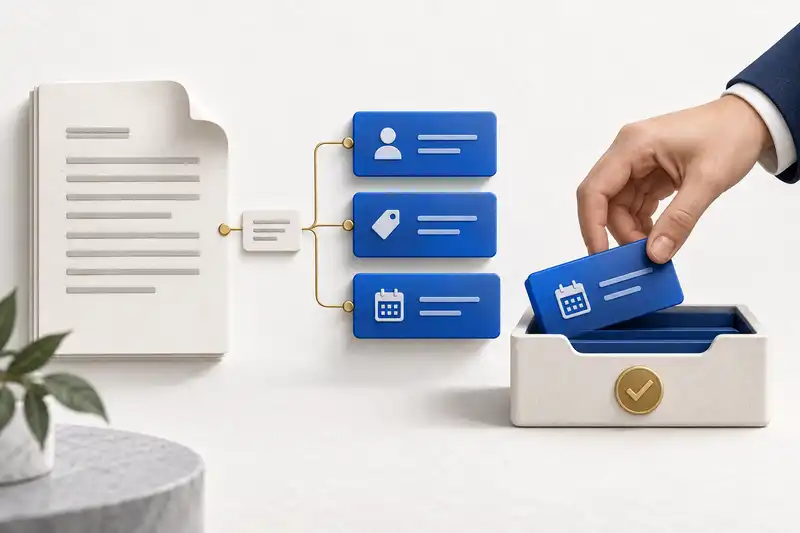
What changes. The agent does the gathering, checking and preparing. Your staff see a prepared action with its reasons and sources, approve or correct it, and the agent completes the agreed steps. Every action is logged, and nothing outside its permissions can happen.
Illustrative agent task
One task, from trigger to approved action.
A generic example, not a client deployment. It shows the controls, not measured performance.
Trigger
A new ticket, email, document or scheduled check starts the task.
Gather
The agent reads the information it is allowed to read, from the agreed systems only.
Check
It applies your rules, compares options and notes anything missing or unusual.
Prepare
It drafts the action, such as an assignment, a recommendation or an update, with the reasons.
Approve
A person approves, corrects or rejects it. Agreed low-risk steps can run without approval.
Act and log
The agent completes the approved steps and records what it did, when and why.
Suitability
Where it fits, and where it doesn’t.
A good fit
Known rules
The steps and decisions can be written down, even if they take time today.
Several systems
The work means copying or checking information across tools.
Enough volume
The task repeats often enough to justify building and running an agent.
A clear approver
Someone owns the decision the agent prepares.
Probably not a fit yet
Open-ended goals
“Run our marketing” or “manage our finances” are not tasks an agent should own.
Irreversible actions without review
Payments, contract commitments and deletions need a person to approve.
No access agreement
If the agent cannot be given limited, auditable access, it should not act.
A rule-based script is enough
If the task has no judgement in it, ordinary automation is cheaper and easier to run.
Integration
Integration boundaries.
Permissions
The agent gets its own account with the smallest set of read and write rights the task needs.
Systems
Only the systems agreed in scope, through their supported interfaces.
Approvals
Which steps need a person, and who, is agreed before the agent runs.
Hosting and processing
The application and its logs can be hosted on Azure UAE North, on private servers managed by Vloud, or in your own cloud account. The AI model is used through a provider agreed per project, and its processing region may be outside the UAE.
Control
Acceptance tests we propose.
Task results
On an agreed set of past cases, does the agent prepare the action your staff would have taken?
Permissions
Is every attempt outside its rights blocked and logged?
Approvals
Do the steps that need a person always wait for one?
Failure handling
When a system is unavailable or data is missing, does the agent stop and hand over?
Pilot
What a pilot delivers.
One task, the systems it touches, its permissions and an agreed set of test cases. Scope and price are confirmed in a written proposal.
Working agent
The agreed task running in a test environment, then on live work with approvals in place.
Test results
Task, permission, approval and failure results on the agreed cases, reported separately.
Action log
A record of every step the agent took, for your team and your auditors.
Running-cost model
Monthly model, hosting, monitoring and maintenance costs.
What drives cost and timeline: The number of steps and systems, how integrations work, the approval rules, the languages and documents involved, the test cases to prepare and ongoing monitoring. We don’t publish a price list; scope, timeline and price come in a written proposal after the discovery call.
Evidence
What you can examine today.
We use agent-style AI in our own products. We have not yet published a client agent deployment, so these pages show the approach rather than client results.
AI-assisted error monitoring with ErrorLens
Our own product: errors grouped and explained, with engineers deciding the fix.Agentina Builder (early access)
Our AI development studio: specialist coding agents with human plan approval.AI maintenance ticket triage
An agent-style workflow: classify, route and prepare the work order for approval.Supplier quotation comparison
Quotes compared against the request, with a buyer approving the recommendation.
Before you start
Questions about AI agents.
What is the difference between an AI agent and a chatbot?
A chatbot answers questions. An agent carries out a task: it reads from your systems, prepares an action and, once approved, completes it. Many projects need only one of the two.
Can an agent act without a person?
Only for low-risk steps agreed in advance. Anything with money, commitments or customer impact waits for approval.
What stops it from doing the wrong thing?
Limited permissions, approval steps, tests on past cases before it runs, and a log of every action. When something is unclear, it stops and hands over.
Which systems can it work with?
Systems with a supported interface, such as an API, a database view or an agreed export. We confirm each one in the discovery stage.
Is our data used to train a model?
Processing terms are agreed per project with the chosen model provider before any data is shared.
Let’s make it work
Tell us which task takes your team the most steps.
Describe the task, the systems it touches and who approves the result. Free 30-minute discovery call.