
Cloud & Infrastructure Engineering
Build a stronger foundation for your software.
Deploy, modernise, and operate applications with infrastructure designed for reliability and change.
- Serving the UAE
- Arabic and English
- We deploy on Microsoft Azure and AWS
- Free 30-minute discovery call
Built around your operation
Confidence in the next release. Visibility into today.
Manual deployments, unclear environments, and missing monitoring make software difficult to operate. We help teams understand the current system and establish a practical foundation for running it.
Cloud environments
Set up application, data, networking, and access around the workload. We deploy on Microsoft Azure and AWS.
Deployment pipelines
Make build, validation, and release steps repeatable.
Monitoring & observability
Expose application health, failures, and operational signals.
Legacy modernisation
Plan changes around dependencies, data migration, and business continuity.
Backup & recovery
Define backup, restore, and recovery procedures against agreed needs.
Performance & scaling
Investigate bottlenecks and plan capacity using observed workload behaviour.
See it in practice
A clear path from code to production.
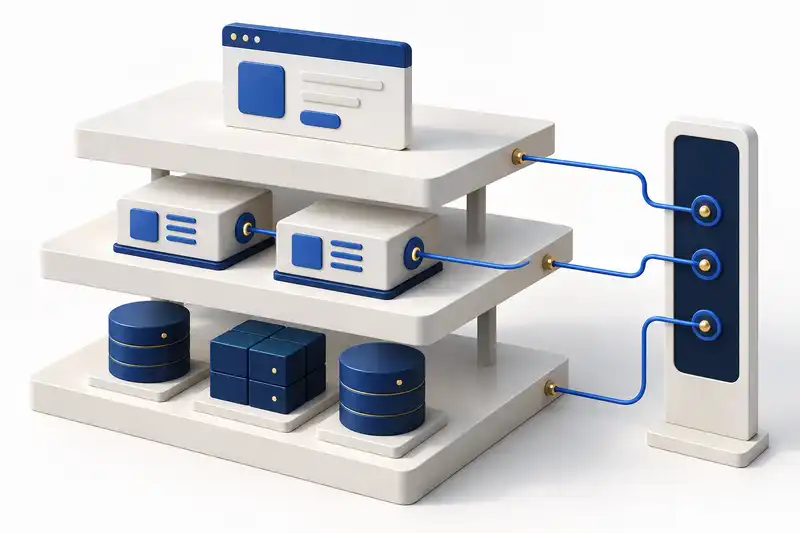
Explore an example release pipeline. Separate environments create room to validate changes; monitoring and recovery planning support the system once it is live.
Environment separation
Give development, validation, and production clear boundaries.
Least-privilege access
Assign operational access according to responsibilities.
Recovery planning
Agree recovery objectives and exercise the relevant restore steps.
Operational ownership
Document who responds, what is covered, and how issues are escalated.
Check changes before release.
Automated checks and a separate staging environment create room to validate the application.
Example architecture — designed around the needs of each system.
From first conversation to handover
How the engagement takes shape.
We agree the scope around your starting point, the people involved, and the systems the work needs to connect. The timeline depends on the project and is confirmed in the written proposal.
Explore our delivery methodAssess
Map dependencies, access, workload, and the current deployment process.
Prepare
Set up environments, pipelines, and recovery arrangements.
Validate
Test application behaviour and migration steps in a suitable environment.
Cut over
Run the agreed release or migration plan with rollback criteria.
Observe
Monitor the outcome and resolve operational issues.
What stays with your team
Pipelines, monitoring and runbooks your team can use.
Deliverables are agreed during scoping. These are the practical outputs this service is designed to provide.
Environment map
An understandable record of services, dependencies, and access.
Release pipeline
Repeatable build and deployment configuration.
Monitoring setup
Agreed health signals, alerts, and operational views.
Runbooks
Deployment, recovery, and support procedures for the team.
Where it fits
A practical application.
Migrating a legacy business platform to a managed cloud environment with monitoring, alerting, and a planned, rehearsed cutover.
Best for: Companies that need their software to run reliably, not just be delivered.
Connected capabilities
Often paired with Cloud & Infra.



Before we get started
Questions about Cloud & Infra.
Can you work with our existing hosting?
Yes, in most cases. We deploy on Microsoft Azure and AWS, and we assess your current provider, architecture, access and operating constraints before recommending changes. A move is only one possible outcome.
Will a migration interrupt the business?
The cutover approach depends on the application and its data dependencies. We plan validation, any maintenance window, and rollback steps explicitly; zero downtime is not assumed.
How much does it cost?
There’s no public price list. We price to your scope and confirm it, with the timeline, in a written proposal after a free 30-minute discovery call.
How long does it take?
It depends on the project. We confirm the timeline in the written proposal, alongside the scope and price.
Who owns what you build?
You do, for the custom work we build for you. It is set out in the engagement agreement. Our own products stay ours.
What happens after launch?
We can host and operate what we build, or hand it over to your team with documentation and training. The support arrangement is agreed with you and confirmed in the proposal.
Who will we work with?
An account manager, plus the engineers on your project. We work in Arabic and English, and we sign an NDA if you need one.
Let’s make it work
Tell us how your software runs today.
Share where it is hosted, how releases happen and what worries you about running it. We’ll start with the current system and agree a practical foundation.