AI & Intelligent Automation
AI document and workflow automation for UAE businesses
Automate document capture and internal workflows with source references, access controls and human review, starting with one bounded task your team repeats every day.
- Serving the UAE
- Arabic and English
- We deploy on Microsoft Azure and AWS
- Free 30-minute discovery call
Built around your operation
Three bounded places to start.
A good first AI project is frequent, has accessible sources and has someone accountable for checking the result. Most fall into one of three shapes. Pick the one closest to your work; a broad chatbot request usually needs narrowing first.
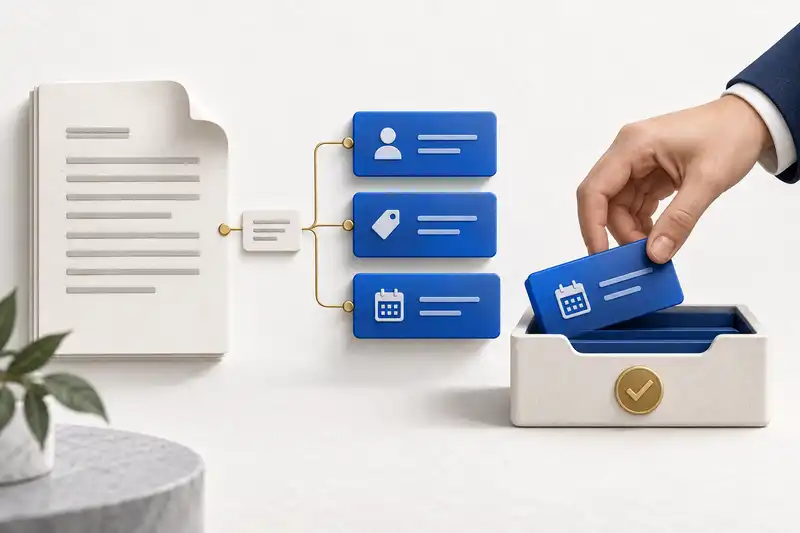
Extract from documents
Invoices, delivery notes, forms and contracts read into structured fields and checked against your records. What changes: less retyping, and every value traceable to where it was found.
Find answers with sources
Search or an internal assistant that answers from your approved documents, shows the passage it used and respects who may see what. What changes: fewer questions waiting on the one person who knows.
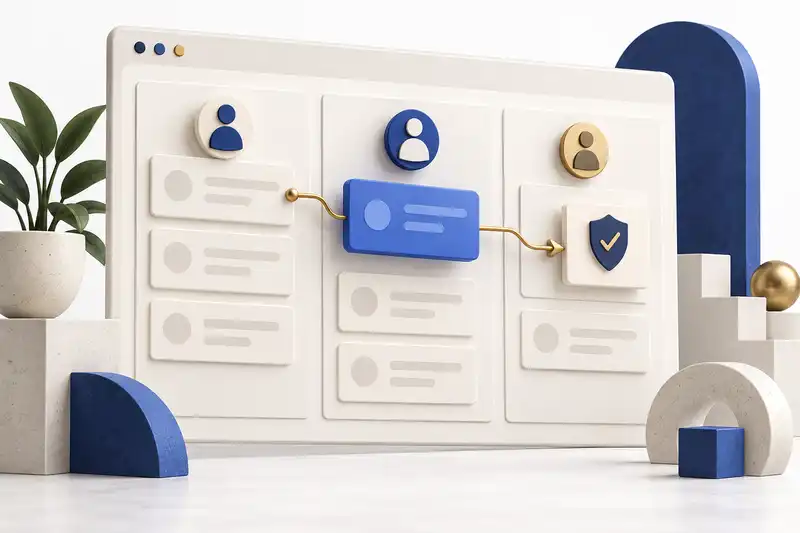
Route a workflow after review
Extracted or drafted information moves to the next step or system only after a person, or a rule you approved, accepts it. What changes: work moves without retyping, and sensitive changes still need sign-off.
Start with one workflow
Two places most first projects begin.
Each one has its own scope, proof and next step. Pick the closest to your work.
Document processing
Invoices, delivery notes and forms read into checked fields, with a person reviewing exceptions before your business system is updated.
See the document workflowAutomotive customer enquiries
Repeated service and booking questions: intake, answers from approved information and a clear handoff to your staff, scoped on top of our delivered automotive portal work.
See automotive operations
Also possible: an internal assistant that answers from one approved source library, with citations and access rights. We scope it on request. Ask about a knowledge assistant
See it in practice
From a document to a reviewed decision.
Follow a sample invoice through extraction, checking and approval. The example uses synthetic data, not a client document. The system prepares the information and flags what it is unsure of; a person reviews exceptions before the business record changes.
Permissions before retrieval
The system checks what a user may see before it searches, so answers draw only on sources they are allowed to read.
Processing agreed per project
Where the application runs, which model provider processes the text, and on what terms, are agreed before any data is shared.
Logging and redaction
Inputs, outputs and reviewer changes are logged, with sensitive fields redacted where agreed, so you can see what happened and why.
No silent changes
Nothing sensitive changes in a business system without a reviewer, or a rule you approved.
Supplier invoice
Information, structured.
- Supplier identified
- Purchase order referenced
- Delivery reference missing
Every field can be checked against its source.
Review requiredConceptual interface — sample data, not a customer screenshot.
Receive
An invoice arrives in the agreed document channel.
Extract
Read the supplier, reference, line items and amount, each linked to where it appears.
Check
Compare the fields with purchase-order data and mark any value the system is unsure of.
Review
A reviewer resolves missing information and approves the result.
Update
Pass the approved record to the connected business system.
How it starts
Your first conversation, and what follows.
The free 30-minute discovery call is about one workflow, not a complete architecture. We look at its volume, where the information comes from, who owns it and what constrains it, then agree whether the right next step is existing software, a scoped assessment or a build.
Discovery call
Free, 30 minutes. One workflow: volume, sources, owner and constraints. Outcome: an honest view of whether custom AI is the right tool.
Assessment, if needed
Scoped separately. A workflow map, data and access inventory, current baseline, cost drivers and a pilot scope.
Bounded pilot
One process owner, one main input source, one output integration, an exception queue, an agreed sample set and acceptance criteria.
Decide
Expand, revise or stop, based on the pilot's evaluation results. Continuing without a useful result is not the goal.
A good fit
A repeated task with real volume, inputs we can access, a person accountable for the result and a system the output should reach.
Probably not yet
A broad “add AI” request with no single workflow, data that can’t be shared or accessed, or a task your existing software already handles. We’ll say so.
What stays with your team
A working AI tool, plus the tests that show it works.
Deliverables are agreed during scoping. These are the practical outputs this service is designed to provide. See how we deliver it
Integrated AI tool
A focused assistant or workflow connected to the agreed sources.
Evaluation pack
Representative test cases and documented acceptance criteria.
Operating guide
Instructions for source updates, access, and exception handling.
Team handover
Practical sessions for the people who use and maintain the tool.
Where it fits
A practical application.
An internal assistant that answers operational questions from contracts, drawings, and policy documents — with citations.
Best for: Companies with repetitive knowledge work, document-heavy processes, or teams that need faster access to operational information.
Connected capabilities
Often paired with AI & Automation.

Compare the options
A standard AI tool, or automation built into your workflow?
| Decision point | A standard AI tool or platform feature is often enough when… | A workflow built for you makes sense when… |
|---|---|---|
| Sources | People work with documents they already hold and can paste or upload themselves | Answers must come only from approved repositories or systems, kept up to date |
| Permissions | Access per user account, as your licence provides, is sufficient | Access has to follow your roles and per-source rules, checked before retrieval |
| Checking the output | The person using the tool reviews each result themselves | Uncertain results must be routed to a named reviewer, with the source shown |
| Actions in other systems | Results are copied into other systems by hand, or the vendor's built-in connectors cover what you need | Approved results must update your ERP or records through an agreed, logged integration |
| Evaluation | Informal checking is acceptable for the risk involved | Quality must be measured against a sample of your documents with agreed acceptance criteria |
| Operation | The vendor's support and roadmap meet your needs | Someone must monitor failures, update sources and run the workflow after launch |
Before we get started
Questions about AI & Automation.
What is a good first AI automation project?
A frequent, bounded task with accessible source documents and someone accountable for checking the result. Extracting fields from supplier invoices, or answering questions from an approved policy library, are typical starting points. A broad chatbot request usually needs narrowing first.
What happens when the AI gets something wrong?
We design for it. Uncertain or incomplete results go to a reviewer before any record changes, every extracted value links back to its source, and errors are logged so they can be studied and reduced.
How will we know it works?
Before building, we agree a representative sample of your documents, the answers a correct result should give, and how the current manual process performs. We then measure field by field, including the exceptions and how much review work remains. We don't quote accuracy or time savings before that test.
Which tasks still need a person?
Anything that needs judgement, carries legal or financial weight, or falls outside the agreed rules. We agree where that line sits before automating anything.
Who can see the source documents?
Only the people your roles allow. The system checks permissions before it retrieves anything, so an answer never draws on a document the user couldn't open.
Where does our data go? Can it stay in the UAE?
The sources, hosting and model provider are agreed during discovery. We work with established providers such as OpenAI and Anthropic, chosen per project, and can host the application in-region when data residency matters. Where the model provider processes text is confirmed for each project.
How are Arabic documents handled?
We test Arabic separately on your own samples, including scanned pages and mixed Arabic and English, because scan quality and layout affect results more than the language itself.
Can you connect AI to our ERP or document system?
Usually, yes. We first review the available APIs, document stores, identity setup and permissions. The integration scope depends on what those systems support.
Is a standard AI tool enough for us?
Often, yes. If people use it for drafting or summarising their own files and check the results themselves, a standard tool your company already licenses may be all you need. Build when the task must use controlled sources, follow your permissions, write to a business system or be measured against agreed criteria.
How much does it cost?
There’s no public price list. We price to your scope and confirm it, with the timeline, in a written proposal after a free 30-minute discovery call.
How long does it take?
It depends on the project. We confirm the timeline in the written proposal, alongside the scope and price.
Who owns what you build?
You do, for the custom work we build for you. It is set out in the engagement agreement. Our own products stay ours.
What happens after launch?
We can host and operate what we build, or hand it over to your team with documentation and training. The support arrangement is agreed with you and confirmed in the proposal.
Who will we work with?
An account manager, plus the engineers on your project. We work in Arabic and English, and we sign an NDA if you need one.
Let’s make it work
Tell us which documents slow your team down.
Describe the documents or task involved and where that information lives. Please don’t attach sensitive documents to the enquiry; we agree how to share a representative sample after the first call. Free 30-minute discovery call.