
Two teams can build the same feature list and ship two completely different systems. One demos well and holds up for years. The other demos just as well, then starts cracking the first time the business changes. The difference is rarely talent or budget. It is where they started.
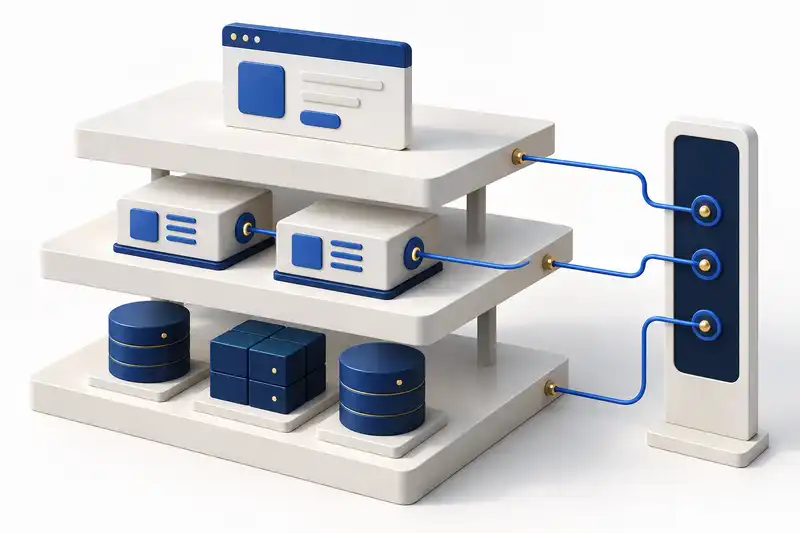
Feature-first teams start with screens. Someone writes a list — approval screen, reports page, user management — and the build becomes a race to make each screen work. Architecture-first teams start with the system underneath the screens: the data model, the roles, the permissions, the integrations, the reporting, and the failure cases. The screens come later, because screens are the easy part.
Here is the claim, and everything below defends it:
Feature-first software breaks after the first wave of change. Architecture-first software absorbs it.
A feature is a promise about today
A feature answers one question someone is asking right now. An architecture answers the questions nobody has asked yet but will. That gap is invisible at launch and expensive later, so it is worth making concrete. Two examples any operations leader in the GCC will recognise.
The approval that later needed delegation and an SLA
An illustrative scenario, not a specific client. A main contractor asks for a payment-certificate approval workflow. The feature-first build is quick: an Approve and Reject button, a status field with three values — pending, approved, rejected — and an email notification. It demos perfectly.
Six weeks into production, the project director travels, and every certificate stalls behind him. Now the business needs delegation. Then finance wants an SLA: anything sitting longer than 48 hours should escalate. Then audit wants to know who approved what, on whose behalf, and exactly when.
None of that fits a status field. Delegation needs an actor model that separates the role from the person holding it. An SLA needs each approval to be a first-class record with timestamps and full state history, not a single column that only remembers its last value. Escalation needs somewhere to put the rules. The feature-first team now rebuilds the core of a live system while people depend on it daily. The architecture-first team modelled one idea on day one — an approval is an event recorded against a document, performed by an actor holding a role — so delegation, SLAs, and audit trails become new rules on an existing model, not surgery. It is the same actor-and-event model we build into the Arkan suite, our own construction and ERP platforms (ArkanCS and ArkanERP), where approvals, delegation, and audit trails have to hold up under real project pressure.
The report that later needed role-based visibility
Then there is the report everyone can see. Feature-first: one query, one table, one page. It works — until the commercial manager should see margin and the site engineer should not. Now visibility has to be enforced per row and per column, by role, across every export and every integration that touches that data.
If permissions were not part of the data model from the start, you cannot add them without touching almost everything. Role-based visibility is not a reporting feature you switch on. It is an architecture decision that happens to show up first in a report.
Where the cost actually lands
The cost of feature-first is nearly invisible at launch, which is the trap. The demo is clean, the timeline looks fast, everyone is satisfied. The cost arrives later, and it compounds. The second module is harder to add than the first. Every change risks breaking something next to it. The team spends more time defending the system than extending it. Eventually the business asks for something entirely reasonable — let the deputy approve when the director is away — and the honest answer is that it means a rebuild.
Software that cannot take the next reasonable request is not finished. It is stuck. And a system that is stuck quietly pushes the operation back to the tools it was meant to replace: the spreadsheet on the side, the approval over WhatsApp, the number nobody trusts.
Deciding the expensive things first
This is why we architect before we build, and why the method runs in one direction on purpose.
We map the workflow first — how a certificate actually moves from site to office to finance, who touches it, where it waits, and what happens when someone is out. We architect the system next: the data model, roles, permissions, integrations, reporting, and the failure cases, written down before a single screen exists. Then we prototype to test the direction while changing it is still cheap, build in modules so usable parts ship in stages instead of one distant launch, and deploy and operate so the system is monitored and maintained in production rather than handed over and forgotten.
Architecture-first is often misread as slow. It is not months of diagrams. It is spending the first week deciding the few things that are genuinely expensive to change later — the data model, the permission model, the integration boundaries — so the next hundred changes stay cheap. Feature-first inverts that. It makes the first change cheap and every change after it costly.
The question to ask a vendor
If you are evaluating a custom build, the useful question is not whether a team can build the features on your list. Most can, and most demos will look fine. The sharper question is what happens when you need delegation, an SLA, or role-based visibility you did not ask for today.
The answer tells you whether you are buying a demo or a system — and which one you will still be running in three years.