
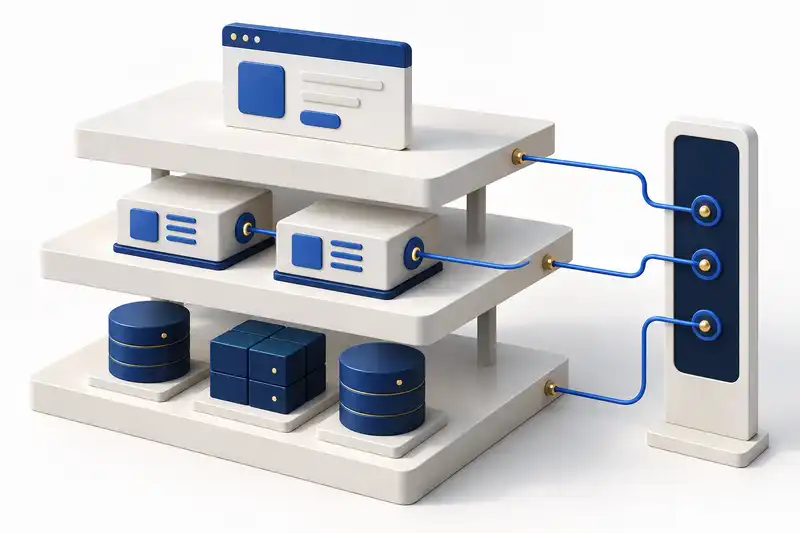
When a vendor says "we'll host and operate it," treat that sentence as a commitment, not a convenience. For an enterprise or government buyer, the application is the visible part. What sits underneath — where it runs, who can reach it, what happens at 2 a.m. when it stops responding, and where the data physically lives — is what carries your operational and regulatory risk.
Read the rest of this the way you would read a returned security questionnaire: point by point, looking for specifics, not slogans. We run two SaaS products for exactly this purpose — Vloud, our hosting and operations platform, which hosts client systems, and ErrorLens, our monitoring and issue-response product. We use both on our own products, and both are offered as SaaS. We deploy on Microsoft Azure and AWS.
Deployment: controlled, repeatable, reversible
A system is only as safe as the way changes reach it. We do not deploy by hand-editing servers. Every release moves through a pipeline in Vloud: version-controlled code, an automated build, a staging deploy, checks, then a controlled promotion to production. The same steps run every time, which makes a release repeatable and — just as important — reversible. If a change misbehaves, we roll back to the previous known-good version instead of debugging live under pressure.
For you, that is a plain answer: changes are tracked, tested before they land, and reversible. Nobody logs into a box to "fix something quickly" without a record.
Environment isolation: keep environments distinct
Development, staging, and production are separated. Test data does not sit next to live data. Client environments are kept distinct from one another, and the degree of separation a system needs is agreed during scoping. Isolation is what stops a problem in one place from becoming a problem everywhere, and it is what lets us reproduce an issue in staging without touching your live operation.
Monitoring and alerting: we watch it so you don't have to
Hosting without monitoring is just storage. ErrorLens gives us continuous visibility into the systems we run — error rates, failures, slow responses, and the early signals that precede an outage. Alerts route to the team responsible for the system, not to an inbox nobody reads. The goal is measurable: we should know a system is degrading before your users open a ticket about it.
Incident response: a defined path, not improvisation
Things break. The difference between a mature operator and a risky one is what happens next. We work to a defined path: detect, triage by severity, contain, communicate, resolve, then review. You are told what happened, what was affected, and what we changed so it does not recur. After a significant incident we run a review focused on the system and the process — not on blame — and the fix becomes part of how we operate.
Hosting is not a server. It is a set of promises about what happens when something goes wrong.
Backups and recovery: recovery is the real test
Backups only matter if you can restore from them. The two questions your continuity team cares about — how recent is the last recoverable point, and how long does a restore take — are answered for each system, not in general. Backup, restore and support commitments are agreed per engagement and written into the agreement.
Access control: least privilege, and a record
Access to production is restricted to the people who need it, scoped to what they need, and logged. Administrative actions leave a trail. Credentials are managed as secrets, not shared in chat. When someone leaves a project, their access leaves with them. This is unglamorous discipline, and it is exactly the discipline that keeps an operational system trustworthy over years.
Data residency: in-region when it matters
For government and regulated buyers in particular, where the data lives is not a detail. We can host in-region when data residency matters to you or your regulators. If your obligations require data to stay inside a specific jurisdiction, that constraint is designed in from the start, not worked around after the fact, and the hosting arrangement is written into the agreement.
After launch: the system keeps getting better
We do not treat go-live as the finish line. Because we host and monitor what we build, we see how a system behaves under real load, and we keep improving it — performance tuning, capacity adjustments, security updates, and the small workflow refinements that only surface once real users are working daily. A system we operate is a system we are accountable for, continuously.
On certifications, honestly
We will be direct about maturity, because you should be able to trust the answer. We don’t claim certifications, and a badge is not a substitute for how a team operates day to day. We describe our practices as they stand — isolation, controlled deployment, monitoring, incident response, access control, in-region hosting where residency applies. Backup, restore and support commitments are agreed per engagement and written into the agreement, so you know exactly what you are getting. An honest operator tells you what they do now, in writing. That is a better basis for trust than a badge with nothing behind it.
The short version
"We'll host and operate it" means Vloud runs it, ErrorLens watches it, changes are controlled and reversible, environments are kept distinct, data can stay in-region when residency applies, access is restricted and recorded, backup and restore commitments are written into the agreement, and there is a named path for what happens when something breaks. That is the promise underneath the sentence — and it is the part worth pressing us on.
If you have a hosting and security questionnaire in front of you, send it over. We would rather answer the hard questions early than after go-live.